

The Complete Guide to Supplements for Skin Health and Collagen
Last Updated: November 4, 2026
Quick Summary
Supplements for skin health supply nutrients such as collagen peptides, vitamin C, zinc and omega-3s that support the skin's barrier, hydration, elasticity and repair processes from the inside. They help most where there is a shortfall to correct, and help least where the diet is already adequate. Give any supplement twelve weeks before judging whether it works.
- Collagen peptides are digested into amino acids, and research on their effects is mixed with results typically gradual.
- Check the peptide dose per serving on collagen products rather than a headline figure on the front of the pack.
- Vitamin A is fat-soluble and accumulates, so long-term high intakes can be toxic.
- High-dose biotin can interfere with laboratory blood tests, including thyroid tests.
- Compare supplements by price per day of actual nutrients, not pack price.
Table of Contents
- How Supplements May Support Skin Health
- Collagen Supplements and Skin Appearance
- How Long for Collagen Supplements to Work
- The Best Vitamins for Glowing Skin
- Skin Health Supplements for Breakouts
- Antioxidants, Omega-3s and Protection from Oxidative Stress
- Biotin, Diet and Topical Skincare Compared with Supplements
- Dose, Formulation, Duration and Safety
- How to Evaluate Supplement Quality and Cost
- Building Your VITTOSKIN Day and Night Routine
- Frequently Asked Questions
How Supplements May Support Skin Health
Skin health is the ability of your skin to maintain its barrier, hydration, elasticity and repair processes, and supplements aim to support those processes from the inside. At Vitto Vitamins, we treat supplements as a considered addition to a routine, never a replacement for a varied diet, sleep and sun protection.
The logic is straightforward: your skin is a living tissue that turns over constantly, and it needs a steady supply of nutrients to do that. Collagen, vitamin C, zinc and omega-3 fatty acids all play defined roles in that turnover. What most guides get wrong is the assumption that taking more of a nutrient automatically means better skin. It does not. Supplements help most where there is a shortfall to correct, and help least where the diet is already adequate.
Below, we explain what each nutrient actually does, how long results take, and how to judge whether a product is worth your money.
Collagen Supplements and Skin Appearance
Collagen supplements are sold as powders, capsules and drinks, and they supply collagen that has been broken into short chains called collagen peptides. Collagen supplements are often marketed as rebuilding the skin's collagen. Collagen peptides are digested into amino acids, and the research on their effects is mixed, with results typically gradual.
Collagen is the structural protein that gives skin its firmness and resilience, and the type found most abundantly in skin is type I collagen. Levels decline with age, which is why fine lines and laxity appear. A supplement cannot stop that decline. It may support the skin's own production alongside a protein-rich diet and vitamin C.
What most guides miss is the dose question. When comparing collagen products, check the peptide dose per serving rather than a headline figure on the front of the pack.
Collagen Peptides, Biosynthesis and Type I Collagen
Collagen biosynthesis is the process by which your body assembles new collagen, and it needs three things: amino acids, vitamin C and minerals such as zinc and copper. Collagen peptides supply the raw amino acids; vitamin C acts as a cofactor in the assembly steps.
This is why a collagen supplement taken alongside a poor diet does little. If you are not eating enough protein, or your vitamin C intake is low, the raw materials and the cofactors are missing and the supplement has nothing to work with. Our view is that collagen peptides are worth trying if your diet is already reasonable, and a waste of money if it is not.
How Long for Collagen Supplements to Work
Judging a collagen supplement takes patience, because skin turnover is slow and collagen remodelling is slower still.
The timeline below gives a general outline of what to watch for:
| Timeframe | What to expect | What to do |
|---|---|---|
| Weeks 1-4 | Little visible change; possible digestive adjustment | Take consistently, note any side effects |
| Weeks 4-8 | Subtle changes in skin hydration and plumpness | Photograph skin in the same light monthly |
| Weeks 8-12 | Firmer feel, possibly softened fine lines | Decide whether the cost is justified |
| Beyond 12 weeks | Maintenance rather than further gains | Continue only if you see benefit |
For a fuller breakdown of what to expect at each stage, read our guide on how long for collagen supplements to work. The short answer is that patience matters more than dose escalation, and stopping at four weeks tells you nothing.
The Best Vitamins for Glowing Skin
The vitamins most often linked to glowing skin are vitamin C, vitamin A, vitamin E and the B group, supported by minerals including zinc and selenium. But "best" depends on what you mean by glow: hydration, barrier function, even tone and collagen support are different outcomes, and the evidence behind each nutrient varies in strength and in the dose studied.
Here is a more useful way to read the label than a top-five list:
- Vitamin C contributes to the normal function of the immune system and is involved in normal collagen formation. Common supplemental forms include ascorbic acid and buffered forms, which are gentler on the stomach.
- Vitamin A contributes to the maintenance of normal skin. Retinol and retinyl esters are the common supplemental forms; beta-carotene is a provitamin A carotenoid. Vitamin A is fat-soluble and accumulates, so more is not better: long-term high intakes can be toxic, and pregnancy guidance advises against high-dose vitamin A supplements.
- Vitamin E is a fat-soluble antioxidant that works alongside vitamin C. Labels usually state alpha-tocopherol equivalents; natural-source d-alpha-tocopherol is more bioavailable than the synthetic dl- form, though the difference is modest at typical doses.
- B vitamins, particularly biotin, niacin and riboflavin, contribute to the maintenance of normal skin. Biotin deficiency is rare outside specific clinical situations, and high-dose biotin can interfere with laboratory blood tests, including thyroid tests.
- Zinc supports normal skin maintenance and wound healing. Zinc citrate and zinc gluconate are common forms; zinc oxide is poorly absorbed. Long-term intakes above the upper limit can interfere with copper absorption, so check combined formulas for overlap.
- Selenium contributes to the protection of cells from oxidative stress. Selenomethionine is the form most often used in supplements; Brazil nuts are a concentrated food source, so accidental over-supply is possible if you eat them daily alongside a supplement.
A common pattern is that people buy a single high-dose nutrient when a broad formula would cover the same bases more safely. The authorised claims above describe the nutrient's role in normal function; they do not mean that taking extra will improve skin that is already adequately supplied. Most practitioners find that supplements help most where there is a shortfall to correct, and help least where the diet is already adequate.
If you want to go deeper on vitamin C specifically, our article on vitamin C immune system food supplements covers forms, doses and how to choose between them. For most people, a modest daily dose from a combined formula is enough, provided the label states the amount per daily serving rather than per capsule.
Skin Health Supplements for Breakouts
Skin health supplements are not a treatment for acne. Topical treatments and professional advice are the usual route for breakouts.
Watch out: high-dose biotin can interfere with laboratory blood tests, including thyroid tests, and has been linked to misleading results. If you have breakouts and your GP wants bloods done, tell them what you are taking.
Anyone with persistent, painful or scarring breakouts should see a GP or dermatologist rather than self-treating with supplements. Prescription topical treatments such as tretinoin remain the best-evidenced option for moderate to severe acne, and no capsule replaces them.
Antioxidants, Omega-3s and Protection from Oxidative Stress
The antioxidants you will see on labels include carotenoids such as lycopene and astaxanthin, flavonoids from green tea and grape seed, resveratrol, curcumin from turmeric, and coenzyme Q10. Each has plausible mechanisms and modest human evidence. None is a substitute for sun protection, which remains the single most effective way to limit skin ageing.
Biotin, Diet and Topical Skincare Compared with Supplements
Supplements sit in the middle: useful for filling gaps, not for replacing the other two. If you are weighing up biotin or a hair, skin and nails formula, our skin hair and nails vitamins label guide shows how to read those labels and spot underdosing.
Dose, Formulation, Duration and Safety
Dose and formulation decide whether a supplement works, and duration decides whether you will notice. A well-formulated product states the nutrient amount per daily serving, uses a form your body can absorb, and does not hide nutrients behind a proprietary blend.
Three practical rules we give customers:
- Check the daily serving, not the capsule. Four capsules to hit the label dose is a different product from one.
- Look for nutrients that overlap with what you already take. Doubling up on zinc or vitamin A is easy to do by accident.
- Give it twelve weeks before judging, and stop if you notice no benefit.
Safety matters more than most articles admit. Some ingredients can cause problems at high doses or interact with medication, so check labels and speak to a healthcare professional if unsure. If you are pregnant, breastfeeding, planning pregnancy, taking medication or managing a medical condition, speak to a pharmacist or GP before starting anything.
VITTOSKIN — Day & Night Skin Supplement →
If you are choosing between a targeted formula and a general one, our guide on how to choose a multivitamin for men women or skin walks through how to match the formula to your actual need rather than the marketing.
How to Evaluate Supplement Quality and Cost
Quality can be judged from what is shown on the pack: ingredient disclosure, nutrient forms and manufacturing information.
Ingredient disclosure. A well-formulated product states the amount of each nutrient per daily serving, not just per capsule, and does not hide nutrients behind a proprietary blend. If a brand will not tell you the exact amount of each nutrient per serving, that is your answer. Watch out for labels that list a "botanical blend" with a total milligram amount but no breakdown; you cannot assess dose or overlap with other products.
Nutrient forms. The form affects absorption and tolerability. Zinc citrate and zinc gluconate are better absorbed than zinc oxide; magnesium citrate and magnesium glycinate are more bioavailable than magnesium oxide; natural-source d-alpha-tocopherol is preferred to synthetic dl-alpha-tocopherol. For collagen, the form matters too: collagen peptides (hydrolysed collagen) are the form used in most published research, and marine collagen differs from bovine in amino acid profile and allergen profile.
Third-party testing and contamination. Supplements are food products, not medicines, so quality depends on the manufacturer's controls. Look for evidence of testing for heavy metals, microbial contamination and, where relevant, prohibited substances.
Cost per day of actual nutrients. The honest comparison is price per day of the nutrients you are actually getting, not pack price. A £10 tub that lasts a fortnight costs more per day than a £30 pack that lasts two months, and a product that requires four capsules to hit the label dose is a different proposition from one that requires one. Divide the pack price by the number of days it lasts at the stated daily serving, then compare that figure against the amount of each key nutrient delivered.
A short checklist we would run through before buying:
-
Are all nutrients listed with amounts per daily serving?
-
Is the form specified (for example, zinc citrate rather than "zinc")?
-
Does the label carry a UK address and batch number?
-
Are allergens declared clearly, including fish, soya and gelatin?
-
Is the price per day stated, not just the pack price?
On cost, convenience has a value too, but only if the formula is one you will actually take consistently. A cheap product you stop taking after a month is more expensive than a well-documented one you finish. If you are choosing between a targeted formula and a general one, our guide on how to choose a multivitamin for men women or skin walks through how to match the formula to your actual need rather than the marketing.
Building Your VITTOSKIN Day and Night Routine
A routine only works if it is simple enough to follow on a bad day. VITTOSKIN Day & Night Skin Supplement (£99.00) is a UK-made food supplement with separate day and night formulas in one pack.
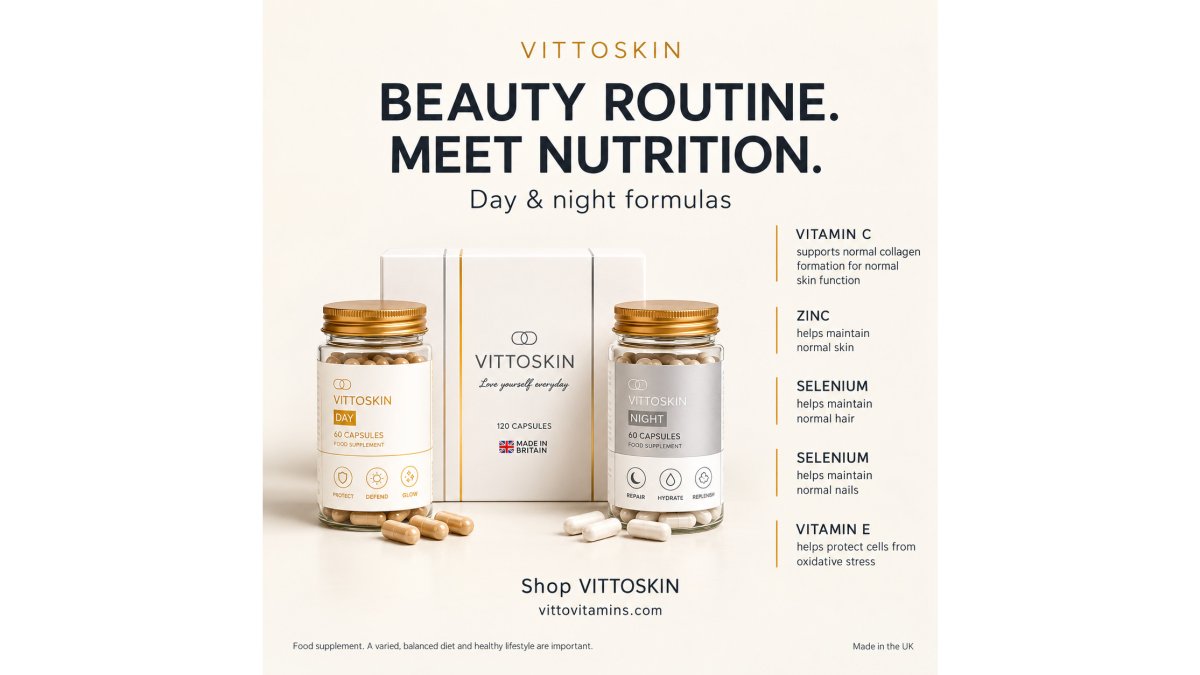
The day formula includes vitamin C, vitamin E, zinc, selenium, turmeric root, grape seed extract, astaxanthin, lycopene and phytoceramides, alongside B vitamins and vitamin D3. The night formula carries marine collagen at 450 mg and hyaluronic acid at 50 mg per capsule.

A simple way to build the routine:
- Take the day capsule with breakfast, when the B vitamins and vitamin D3 fit naturally into your morning.
- Take the night capsule with your evening meal, so the marine collagen and hyaluronic acid become part of an existing habit.
- Keep the pack somewhere visible. A routine you have to hunt for is a routine you will drop.
Watch out: the pack contains fish (marine collagen), soya (lecithin), wheat-derived phytoceramides and gelatin capsule shells. If you have allergies to any of these, check the full allergen declaration before ordering. Do not exceed the recommended daily dose, and if you are pregnant, breastfeeding, planning pregnancy, taking medication or managing a medical condition, ask a pharmacist or healthcare professional first. Food supplements should not replace a varied, balanced diet and a healthy lifestyle, and they should be kept out of the sight and reach of children.
You can view the full ingredient breakdown and explore the VITTOSKIN Day & Night supplement before deciding whether it fits your routine.
Skin supplements are best judged on disclosure, dose and duration rather than on the front of the pack. If you want a routine that separates day and night nutrients into one clearly labelled pack, Vitto Vitamins offers VITTOSKIN with a full ingredient list and a made-in-the-UK format designed to be followed.
Frequently Asked Questions
How long does it take for collagen supplements to work on skin?
Most clinical studies that report visible changes run for at least eight to twelve weeks, and many last six months. Collagen turnover in skin is slow, so a few days tells you nothing. Consistency matters more than the exact time of day you take them.
Are collagen supplements effective for skin health?
Collagen supplements are sold for skin health, but the outcomes described in research vary. Treat any collagen product as one input alongside sun protection, a varied diet and topical skincare, not a replacement for any of them.
What vitamins are best for skin health and collagen production?
Vitamin C contributes to the normal function of the immune system and is involved in normal collagen formation. A varied diet is the best source of these nutrients, and a supplement can help where intake is low. Check labels for overlapping doses if you take more than one product.
Can supplements help with skin breakouts and texture?
Supplements are not a treatment for breakouts. If breakouts are persistent, painful or leaving marks, see a GP or pharmacist rather than self-treating with supplements alone.
What is the best time of day to take skin supplements?
Taking the day and night formulas at consistent times of day can help you remember the routine. Follow the directions on your pack for timing.
Is VITTOSKIN suitable if I have sensitive skin or a history of breakouts?
VITTOSKIN is a food supplement, not a topical product, so it does not sit on the skin. It contains marine collagen, soya lecithin and wheat-derived phytoceramides, all declared as allergens, plus gelatin capsule shells. If you have sensitive skin, a known allergy or you take medication, check the full ingredient list and ask a pharmacist before starting. Food supplements should not replace a varied, balanced diet.
